A Journey of Artistic Discovery Across Europe
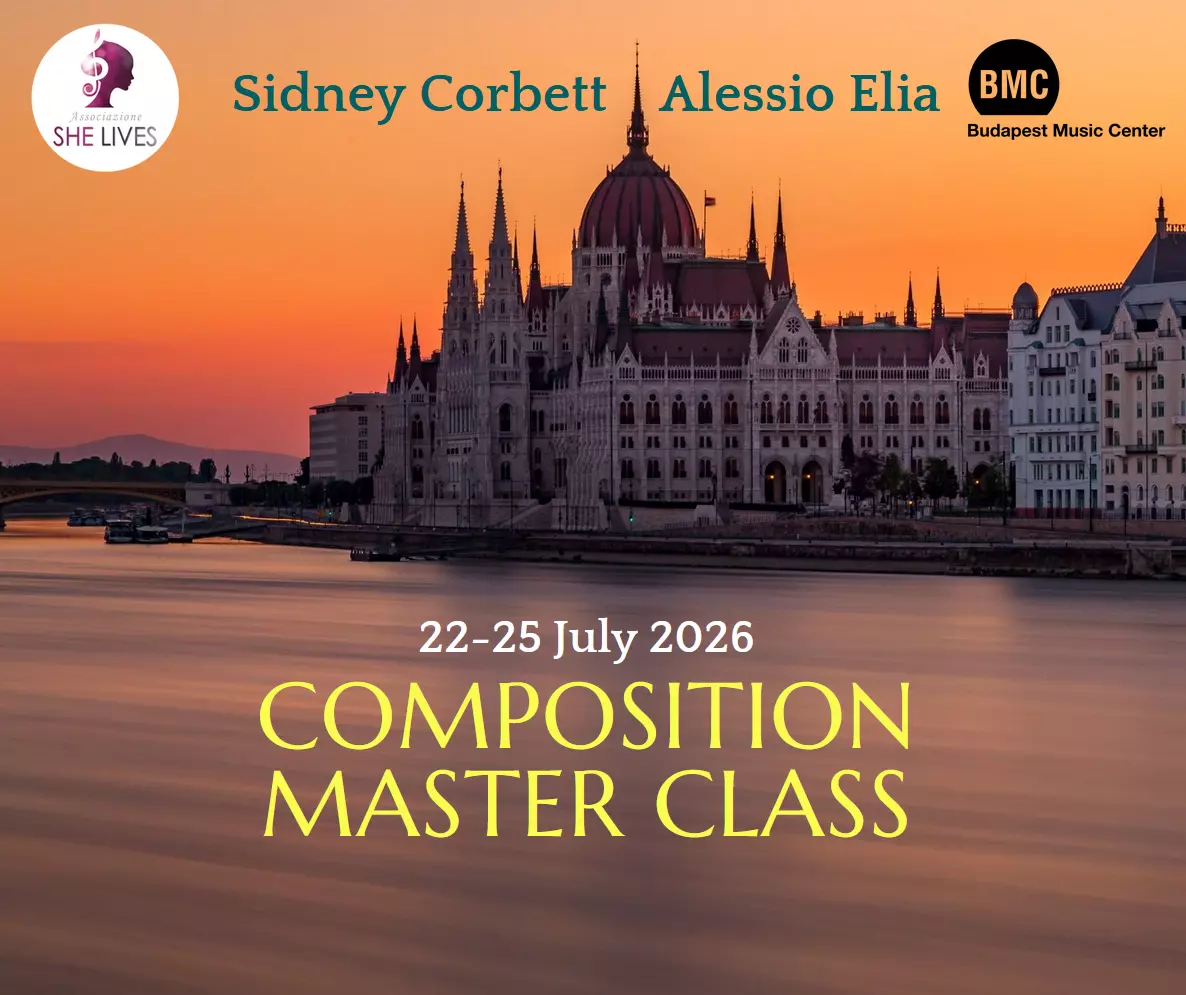
BUDAPEST MASTER CLASS IN COMPOSITION
She Lives
Deadline
Participation fee
Active Students: 560 €Listeners: 300 € (also online)
BUDAPEST MASTER CLASS IN COMPOSITION 2026
SHE LIVES— the leading European musical association for promoting the dissemination of contemporary music — is honoured to announce its 8th Master Class in Composition.
About SHE LIVES
SHE LIVES is a not-for-profit organisation. Since its establishment it has had the privilege of working with internationally acclaimed artists such as Peter Eötvös, Lasse Thoresen and Sidney Corbett, as well globally renowned institutions, including the Solisti della Scala di Milano, the Teatro dell’Opera di Roma, the Accademia Chigiana di Siena, the Accademia Filarmonica Romana, the Fondazione Scelsi, the Reale Ambasciata di Norvegia, the Istituto Svizzero di Roma, the UMZE (the historic ensemble founded by Bartók), the Budapest Music Center, the LAC – Lugano Arte e Cultura, the Festival oggimusica, the Yamaha Concert Hall Wien, the Pro Helvetia, the Contemporary Art Festival Budapest, Warner Classics, Brilliant Classics, and Naxos.
GENERAL INFO
Period: 22-25 July 2026
Place: BMC – Budapest Music Center
Address: Mátyás utca 8- 1093 Budapest.
Ensemble in Residence:
- flute descending to B (doubling: flute with glissando headjoint, piccolo and alto flute) - 1 player
- violin
- cello
- piano (prepared piano is not accepted)
Final Concert: 25 July 2026. BMC – Budapest Music Center.
PROFESSORS: Sidney Corbett, Alessio Elia
COURSES
Sidney Corbett / Alessio Elia
- Post-tonal harmony
Harmony is often a neglected factor in contemporary compositional approaches.
This is due to a progressive lack of interest in considering the parameters on which music is structured.
Even compositional approaches centered on the handling of sound objects—such as musique concrète realized through acoustic instruments—can clearly investigate the harmonic dimension within their own field of interest.
This is to say that no sonic language can be considered valid without containing an internal harmonic dimension, however far this may be from a traditionally oriented conception.
Sidney Corbett
- Subjective analysis
An inquiry into the textuality of music that examines the subjective responses produced by specific materials, not as expressions of individual preference, but as resonances emerging from the deployment of those materials.
Alessio Elia
- Non-preexistence of sound and the indeducibility of sonic phenomena in Polysystemism.
Recent compositional research has often focused on sound as noise, or on the thresholds between sound and silence and between pitch and noise. While productive, these approaches still tend to treat sound as a pre-existing object—something given in advance.
Whether in spectral music, where sound functions as a structural basis, or in musique concrète, where it appears as an objet trouvé, sound is generally understood as something that can be analyzed, combined, or transformed, without questioning its ontological status.
This course proposes instead a framework grounded in polysystemism and in the idea that sound does not pre-exist its manifestation. It introduces the notion of sonic non-deducibility, which resists prediction and allows sound to emerge as a singular, unrepeatable event in performance. Sound is thus conceived not as an object to be manipulated, but as an emergent phenomenon to be explored.
Polysystemism—the simultaneous use of different tuning systems—is grounded precisely in this conception of sound.
ACTIVE PARTICIPANTS
Active students are entitled to attend the courses, and invited to discuss their own works with professors during individual meetings. They can also take part to the final concert with a piece written for the ensemble in residence.
PASSIVE PARTICIPANTS - AUDITORS (also online)
Passive participants are entitled to attend the courses and the discussions of active students about their works, but they cannot discuss their own works with the professors.
Passive participants are invited to attend the rehearsals and the final concert of active students, but they cannot propose their own works.
LANGUAGES
The course is held in English.
Individual meetings can be done in the following languages: English, German, Spanish, Italian, German, Hungarian.
PERFORMANCE OF THE ACTIVE STUDENTS’ PIECES
The Master Class provides the performance of the active students' pieces during the final concert (25 July 2026. BMC – Budapest Music Center).
Composers are invited to write a piece for the ensemble in residence (with a conductor):
- flute descending to B (doubling: flute with glissando headjoint, piccolo and alto flute) - 1 player
- violin
- cello
- piano (prepared piano is not accepted)
The piece can be written for any combination of the instruments present in the ensemble, from a solo instrument to the whole ensemble (including all intermediate formations: duo, trio), and must not be longer than 6 minutes.
APPLICATIONS
There are two types of applications: active students and passive students (auditors - also online).
The registration procedure and the required documents are specified on the Master Class web page:
https://www.shelivesmusic.it/composition-master-class.html
FEES
Active Students: 560 €
Listeners: 300 € (also online)
DEADLINES
Active students and Auditors (selected through the selection process)
30 June 2026
Direct application as a passive student
21 July 2026
More info at: https://www.shelivesmusic.it/composition-master-class.html
For questions: info@shelivesmusic.it
Deadline
Participation fee
Active Students: 560 €Listeners: 300 € (also online)