A Journey of Artistic Discovery Across Europe
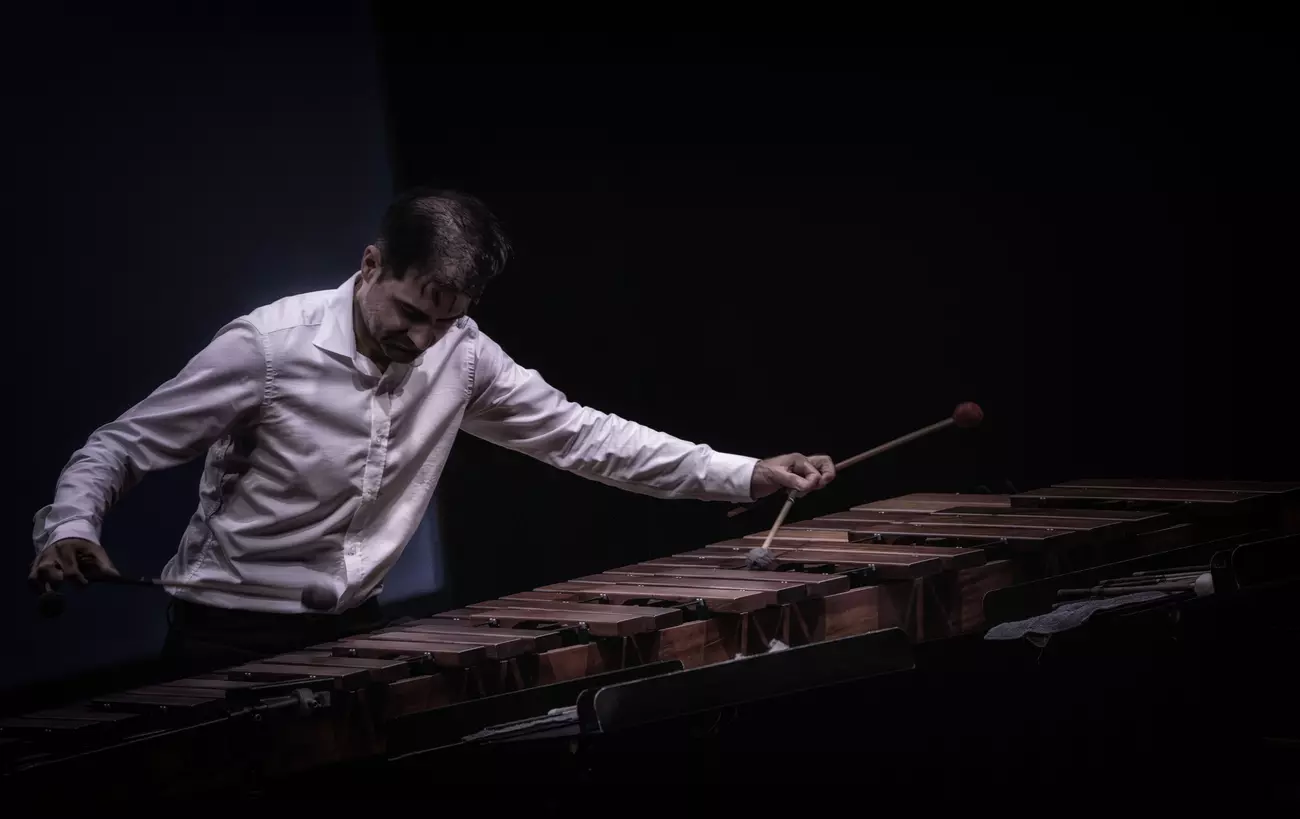
Orchestral + Solo Percussion Academy 26/27 with Moliner
David Moliner
Deadline
Participation fee
€375 per monthly session (8 months)Orchestral + Solo Percussion Academy 26/27 with Moliner
Special Edition: Beethoven 200
Global Publication Opportunity via Universal Edition & Premiere at Philharmonie Berlin
Special Bicentenary Edition: Reflecting on Beethoven's Symphonic Thought
1. Program Overview
The Orchestral + Solo Percussion Academy 26/27 with Moliner is an advanced mentorship program for emerging composers and advanced composition students. The curriculum focuses rigorously on contemporary orchestral thinking, rhythm as a structural force, and an expanded instrumental language.
Led by the internationally renowned composer and percussionist David Moliner, the academy offers an intensive 8-month creative process combining high-level individual mentorship and collaborative orchestral workshops. Each selected participant will develop two original large-scale works:
• One major orchestral composition engaging with symphonic forms (Note: Due to the complexity of large-scale symphonic writing, the structural and conceptual development will take place during the academy, with an extended deadline for the final orchestration and materials submission).
• One advanced solo work for marimba and (or) multi-percussion.
Global Publication Opportunity
In collaboration with Universal Edition (UE), the academy offers all participants the exclusive opportunity to submit both works developed during the program to the digital scodo platform free of charge for official publication and global distribution, subject to evaluation by the UE Artistic Committee.
2. Artistic Focus: Core Pillars Explained
This special Beethoven 200 edition investigates how Ludwig van Beethoven's radical symphonic thought can be translated into 21st century avant-garde composition. Rather than historical or stylistic imitation, the academy approaches Beethoven as the ultimate pioneer of raw musical energy, structural obsession, and visceral dramaturgy, updating his 19th-century radicalism for today's new musical language.
The program investigates this artistic lineage through five core pillars:
• Rhythm as an Architectural Principle: Beethoven proved that a simple rhythmic motif could serve as the entire bedrock of a monumental symphonic structure. In this academy, rhythm is treated not just as a pulse, but as a structural brick. Participants will explore generative systems—such as rhythmic algorithms, proportional structures, and complex metric modulations—where temporal processes actively dictate harmonic shifts, pacing, and macroform.
• Large-Scale Formal Design: A master of long-range dramaturgy, Beethoven knew how to stretch formal and emotional tension across immense spans of time to achieve explosive, highly anticipated structural resolutions. Composers will develop specific strategies to sustain musical tension over complex, 15-to-20-minute symphonic frameworks, mastering transformation and structural continuity to keep the listener captive from the first gesture to the last.
• Sonic Energy: Beethoven’s music permanently shattered the polite dynamic boundaries of the Classical era through violent contrasts, extreme sforzandi (sfz), and unprecedented orchestral masses. We treat sound not just as pitch and harmony, but as acoustical and physical energy. The curriculum analyzes how the combined weight of the orchestra and percussion can be used to sculpt acoustic intensity, volume, and sonic saturation—treating physical performance pressure as a primary compositional tool.
• Physicality and Gesture: There is an inherent bodily struggle built into Beethoven's writing; musicians must physically strain and exert extreme force to execute his vision. This pillar connects directly to the choreographic reality of contemporary percussion and orchestral performance. Composers will learn to notate the movement of the body, understanding that instrument geometry, ergonomics, spatial layout, and the performer's physical resistance are just as vital to the work as the notes on the staff.
• Instrumental Expansion: Beethoven permanently altered the colors of the orchestra by pushing instrument capabilities to their breaking point and introducing new timbres to the symphonic world. Continuing this revolutionary path, participants will master extended techniques and advanced orchestration to unlock new acoustic colors within the symphonic mass, while fully transforming the percussion section into a highly sophisticated, dominant soloistic force.
3. Program Structure & Timeline
The academy takes place over an eight-month period from October 2026 until June 2027 through an advanced online format using high-definition audio, score-sharing systems, and interactive seminars, allowing international participation without relocation.
3.1 Collective Sessions – Orchestral Lab
Participants meet monthly in an advanced online collective workshop environment dedicated to the gradual development of their orchestral composition. Moving beyond pure aesthetics, this lab acts as a real-world simulation of a professional orchestra commission. Topics include:
• Symphonic Form, Advanced Orchestration & Structural Energy: Analyzing contemporary approaches to large-scale symphonic architecture. Exercises will focus on rhythmic systems, complex textural layers, structural thinking, and the explosive integration of the percussion section into the orchestral mass.
• The Pragmatics of Orchestral Commissioning & Rehearsal Psychology: Learning how to write music that maximizes efficiency under tight professional rehearsal constraints. Sessions will cover standard international notation protocols, layout optimization, and how to create crystal-clear orchestral parts to ensure conductors and musicians respect your artistic vision from the first reading.
• Acoustic Projection, Balance & Sound Mass: Strategies for controlling orchestral dynamics, managing sonic density, and preventing large instrumental masses from muddying or masking key structural materials. Composers will learn to calculate acoustic weight and projection in large concert halls.
• The Creative Lab: Peer Defense & Professional Critique: A regular platform for score presentation, collective peer analysis, and rigorous artistic feedback. Participants will practice pitching, explaining, and defending their complex scores, building the communicative confidence required when working with artistic directors, elite conductors, and institutional boards.
The orchestral works developed during the academy will be considered for future collaborations and performance opportunities with David Moliner and associated orchestras for the 27/28 season.
3.2 Individual Sessions – Solo Percussion & Orchestral Integration
Each participant receives monthly individual mentoring sessions dedicated to the creation of the solo percussion work. These sessions move beyond basic orchestration to tackle the advanced mechanics of contemporary percussion writing and its complex relationship with the symphonic mass through three specialized lenses:
• Ergonomics, Spatial Layout & Symphonic Spatialization: Designing efficient, realistic setups for multi percussion and marimba. Mentorship focuses on the geometry of instrument placement, mallet/stick selection, and performance feasibility. Crucially, we analyze the physical layout of the soloist in relation to the orchestra, addressing stage geography, visual cues with the conductor, and how the physical setup impacts the acoustic layout of the stage.
• Acoustic Architecture, Balance & Orchestral Interaction: Exploring the intersection of sound design, timbral architecture, and the body. Sessions dissect extended techniques (dampening, dead strokes, bowing, multi-phonic mallet techniques) to extract new colors. A primary focus is placed on orchestral balance: how to write for the soloist so the work cuts through, blends with, or disrupts the massive acoustic weight of the full orchestra without being sonically masked.
• The Soloist-Orchestra Dialectic & Tour Readability: Bridging the gap between abstract concept and physical realization. Participants engage in the real-world process of testing materials with the performer, analyzing how the solo part dialogues with orchestral cues. Composers learn how to build a highly polished, concert-ready score where both the solo part and the orchestral accompaniment are optimized for the tight rehearsal schedules and acoustic demands of international touring.
3.3 Professional Development & Industry Dynamics
This academy features dedicated, specialized modules focusing on the professional and financial realities of a modern compositional career. Participants will receive direct, practical guidance on:
• Commission Fees & Contract Negotiation: How to calculate, value, and negotiate professional fees for orchestra, ensemble, and solo commissions according to European and international standards.
• Navigating the Publishing World: Understanding the inner workings of copyright, rental libraries, and maximizing digital distribution tools like UE.
• Conductor & Institution Communication: Strategies for presenting complex scores to conductors, pitching projects to artistic directors, and managing professional relationships with orchestral administrations.
• Artistic Self-Management: Effective promotional strategies, portfolio presentation, and building sustainable professional networks.
4. Professional & Artistic Outcomes
4.1 Universal Edition Publication Opportunity
Every participant who successfully completes the academy criteria will receive a free submission waiver to enter their two newly composed works into Universal Edition's digital scodo platform. Upon successful evaluation and acceptance by the official UE Artistic Committee in accordance with their quality guidelines, the works will be officially published and integrated directly into the official UE catalogue, gaining permanent international distribution, global copyright protection, and direct exposure to major orchestras worldwide.
4.2 Solo Percussion Work Premiere & Documentation
The solo percussion works completed by June 2027 will be officially premiered by David Moliner during his high-profile international Beethoven Anniversary Tour (November–December 2027). This includes a featured cornerstone performance at the Philharmonie Berlin, alongside a curated circuit of leading international music festivals and concert halls (specific tour venues, partner festivals, and additional dates to be officially confirmed).
To ensure long-term professional impact, selected percussion works will also receive professionalgrade, high-definition audio recordings. This documentation will serve as an invaluable, elite asset for the composers’ international promotional portfolios and future project proposals.
4.3 Professional Industry Exposure
Participants gain exclusive access to professional rehearsals and working environments involving elite ensembles and performers in David Moliner’s 2026/27 project schedule (such as the Palau de la Música de Barcelona, Barbican Quartet, Orquesta de Valencia, OSCyL, or violinist Carolin Widmann). Furthermore, selected composers will gain access to strategic networking opportunities, including the prestigious Classical:NEXT 2028 global cycle.
5. Tuition & Financials
• Tuition Fee: 3,000 EUR (Total Program Value)
• Payment Structure & Breakdown: To ensure financial accessibility, the tuition is distributed into monthly installments of 375 EUR per session/month (375 EUR × 8 months = 3,000 EUR). Payments are made progressively per month, not upfront as a single lump sum.
What each 375 EUR monthly installment includes:
• 1 Hour of Individual Mentoring Session (Percussion / Orchestra Composition).
• 1 Hour of Collective/Group Workshop Session (Orchestral Lab + Professional Development Modules).
• Free submission fee and evaluation process for Universal Edition's scodo publication program.
The Beethoven 200th Anniversary Excellence Prize (Full Scholarship) At the conclusion of the academy, an international jury consisting of David Moliner and representatives from collaborating institutions will award a full 100% tuition reimbursement (3,000 EUR) to one outstanding participant based on artistic excellence, structural originality, and conceptual strength.
6. Key Dates & Deadlines
• Application Deadline: 30 September 2026
• Results Announcement: 10 October 2026
• Official Academy Start: 15 October 2026
• Mentorship & Seminar Period: October 2026 – June 2027
• Deadline for Solo Percussion Work: 30 June 2027 (To allow for rehearsal and tour preparation)
• Universal Edition Submission & Evaluation Process: From June 2027
• Beethoven Anniversary Tour & Berlin Premiere (Percussion): November – December 2027
• Extended Deadline for Final Orchestral Score & Materials: 15 December 2027 (Providing participants with extra time to fully refine their symphonic orchestration)
• Classical:NEXT Cycle: Spring 2028
7. Eligibility & Application Requirements
The program is open internationally to advanced composition students and emerging professional composers with no age restrictions. Applicants must submit a single, comprehensive PDF document containing:
• Statement of Concept (Max. 600 words): Outlining motivation, artistic relationship to Beethoven's symphonic language, and creative concepts for both the proposed orchestral and solo percussion works.
• Short Biography (Max. 300 words).
• Artistic Portfolio: A complete list of works alongside two scores of selected compositions (any instrumentation).
8. Selection Process & Submission
Selection is highly competitive and is based on artistic originality, technical mastery, and conceptual alignment with the academy's framework. A strict number of composers will be selected for full participation, with other candidates placed on a waiting list to ensure the highest quality of personalized mentorship.
Applications must be submitted as a single PDF via email to:
mentoringprogram.moliner@gmail.com